History
The Letter That Made Seiko Build a Watch for the Abyss
The Seiko “Tuna” did not come out of a marketing workshop or a nostalgic revival. It began with a complaint from a professional diver who needed his watch to keep working where ordinary watches stopped being tools.
A letter from the real world
In 1968, Seiko received a letter that was anything but flattering. It came from Yo Oshima, a professional diver from Hiroshima who worked at depths approaching 350 metres. His point was blunt: the dive watches available at the time were not built for the job he was doing.
At those depths, the challenge was not simply surviving a pressure rating printed on a dial. Saturation diving meant spending long periods in pressurised, helium-rich environments. A working watch had to remain readable, shrug off knocks, stay usable with gloves, avoid snagging and survive decompression. A watch could look rugged in a display case and still be badly suited to life offshore.
Seiko chose not to answer with a tougher version of what it already had. Taro Tanaka, one of the company’s defining designers, led a project that forced the team back to first principles. They went to Kure, spoke with professionals and watched how divers actually worked. That decision explains the Tuna better than any spec sheet: before deciding what the watch should look like, Seiko decided to understand what it had to do.
Seven years of unlearning the conventional dive watch
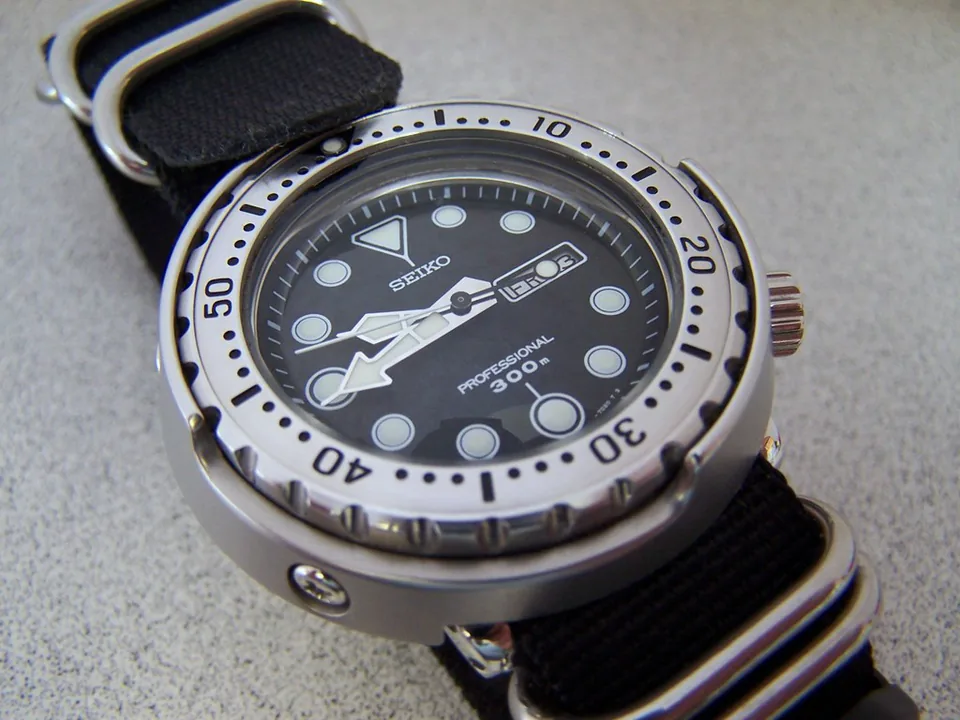
The answer arrived in 1975 as the Professional Diver’s 600m. It looked almost confrontational: a titanium monocoque case, an external protective shroud, a deeply recessed crystal, crown at four o’clock, guarded bezel and an accordion-style polyurethane strap designed to accommodate the changing thickness of a diving suit.
Nothing was there merely for effect. Titanium offered strength, low weight and corrosion resistance. The one-piece case removed a potential route for water and gas. The shroud protected vulnerable parts from direct impact. The crown sat out of harm’s way. Even the strange-looking strap addressed a real problem: neoprene compresses at depth, so the fit of a normal strap changes during a dive.
Helium forced Seiko to take an even less conventional route. Rather than treating gas ingress as inevitable and focusing only on venting it during decompression, the engineers pursued a case that was exceptionally resistant to helium penetration in the first place. Later JAMSTEC testing found the Professional Diver’s 600m to be up to ten times less permeable to helium than comparison watches. The solution was not a gadget attached to the case. It was the case.
When the ocean became the test bench
A 600-metre rating sounded impressive on paper. The more interesting question was what happened beyond it. In 1983, two Professional Diver’s 600m watches were mounted outside JAMSTEC’s Shinkai 2000 submersible. They went down to 1,062 metres — far past their official rating — and returned with their legibility, accuracy and exterior integrity intact.
Seiko came back for another round in 2014 with JAMSTEC’s KAIKO 7000II. A quartz Tuna finally stopped at 3,284 metres. The automatic SBDX011 kept going until 4,299 metres. Neither watch had been sold with anything close to those figures on the dial. This was not a warranty claim. It was engineering curiosity taken to the edge.
How function accidentally drew an icon
The nickname “Tuna” came from the watch’s can-like silhouette. What could have remained a joke became a term of affection. That feels appropriate, because the watch never tried to be conventionally handsome. Its appeal arrived later, once people understood why every awkward-looking part existed.
That is what gives the story its staying power. The Tuna was not created because a designer wanted something distinctive. It was created because a diver wrote to Seiko and said the available tools were not good enough. Seven years later, the company answered with a watch that looked strange precisely because it had allowed the problem to dictate the form.
Plenty of watches are designed to become icons. The Tuna did it backwards: first it had to survive. The icon came afterwards.