History
John Harrison and H4: The Machine That Turned Time into a Coordinate
In the eighteenth century, a ship could work out with reasonable confidence how far north or south it had sailed. The frightening part was not knowing how far east or west it had drifted. Solving that problem would require an English carpenter to build one of the most remarkable timekeepers ever made.
Picture the Atlantic on a night in the eighteenth century.
No satellites. No radio. No GPS. No glowing screen placing the ship neatly on a chart. There is only darkness, wind, timbers working under strain and thousands upon thousands of square kilometres of ocean.
The captain can look to the sky. He can measure the height of the Sun or use the stars and, with the right instruments and tables, establish latitude reasonably well: how far north or south the ship lies.
Longitude is the troublesome coordinate.
The vessel may be much closer to land than anyone believes. It may be hundreds of miles farther east. A small error can mean missing an island, sailing past a harbour or discovering a coastline at night in the least forgiving way imaginable.
For centuries, that uncertainty occupied astronomers, navigators, mathematicians and governments. And the practical solution eventually came down to something deceptively simple: knowing the time.
The ocean needed a clock
The underlying idea was already understood. Earth turns through 360 degrees in roughly 24 hours. A difference of one hour between two places therefore represents 15 degrees of longitude; four minutes represent one degree.
If a navigator could establish local noon from the Sun while carrying an accurate time reference for a place of known longitude, the difference between the two times could be converted into an east-west position.
On paper, it is beautifully simple. The difficulty lies in the word accurate.
At the equator, four seconds of time correspond to roughly one nautical mile of longitude. A clock that accumulated error day after day could turn a seemingly small mechanical imperfection into a serious navigational mistake after weeks at sea.
And eighteenth-century clocks had a formidable enemy: the ship itself. A fine pendulum clock might behave superbly in a house, but a house does not pitch, roll, change climate on the way to the Caribbean or take a pounding in a storm.
The clock had to leave the calm of the workshop and learn to survive the sea.
Britain made the challenge a matter of national importance with the Longitude Act of 1714, offering substantial rewards for a method accurate enough to determine longitude at sea. Allowing for the obvious differences, it was something like an eighteenth-century space race.
Into that race stepped John Harrison.

A carpenter among astronomers
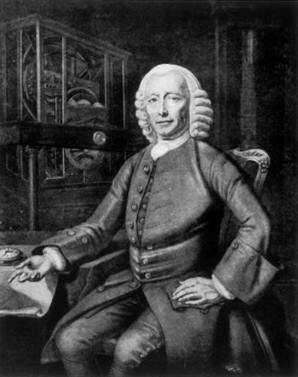
John Harrison did not look like the obvious person to solve one of the great scientific problems of his age. Born in 1693, he had trained as a carpenter and was largely self-taught as a clockmaker.
What he possessed was a rare combination: an intuitive grasp of mechanics and an unwillingness to accept poor behaviour from a machine simply because generations of craftsmen had learned to live with it.
He built the instruments now known as H1, H2 and H3 in succession. They were extraordinary objects - large, complex and experimental - each trying to separate accurate timekeeping from ship motion, friction and temperature.
Harrison spent years on H3. Then the direction of the problem shifted. Perhaps the answer to the ocean did not require an even larger machine. Perhaps it needed a smaller one.
In 1753 the London watchmaker John Jefferys made Harrison a pocket watch incorporating several of his ideas. Its performance was promising enough to make Harrison reconsider a path he had followed for decades.
The future of marine timekeeping might not look like a great shipboard clock after all. It might look like an oversized pocket watch.
Work on H4 began in 1755. Four years later, it was complete.
H4: enormous for a pocket, tiny for a revolution
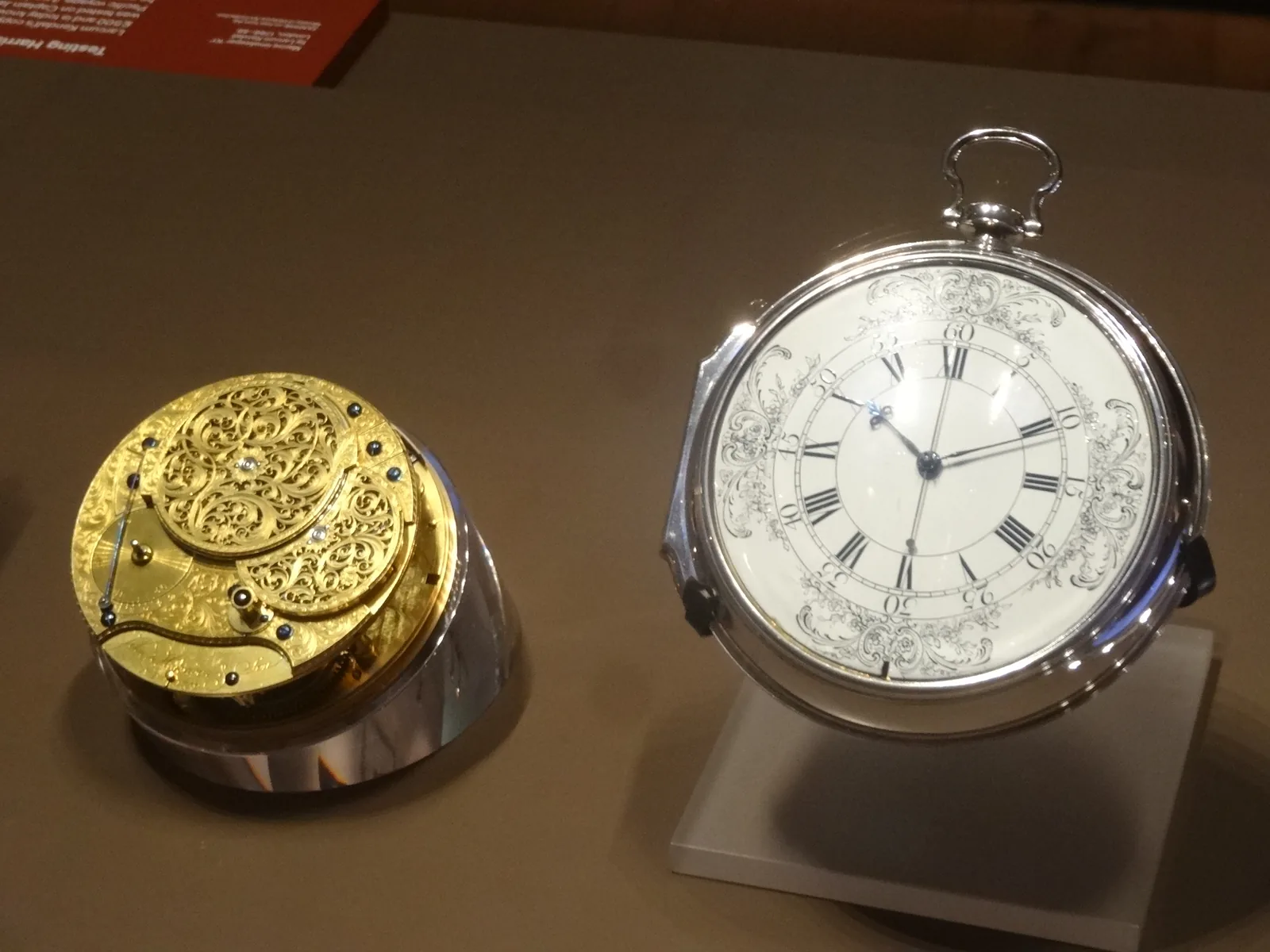
H4 is startling when placed beside Harrison's earlier machines. It does not look like nautical equipment. It looks like a pocket watch enlarged until it became almost absurd.
The National Maritime Museum records a dial 102 millimetres across and overall dimensions of 165 by 124 by 28 millimetres, with a mass of about 1.45 kilograms. Inside are brass, steel, silver, diamond, ruby, copper, enamel and glass.
But size is the least interesting thing about it. What matters is what Harrison managed to put inside.
H4 brought together solutions aimed at the traditional enemies of mechanical precision: changing driving force, temperature, friction, motion and imperfect isochronism. It was not one miraculous invention. It was a system.

Diamonds where other watches found friction
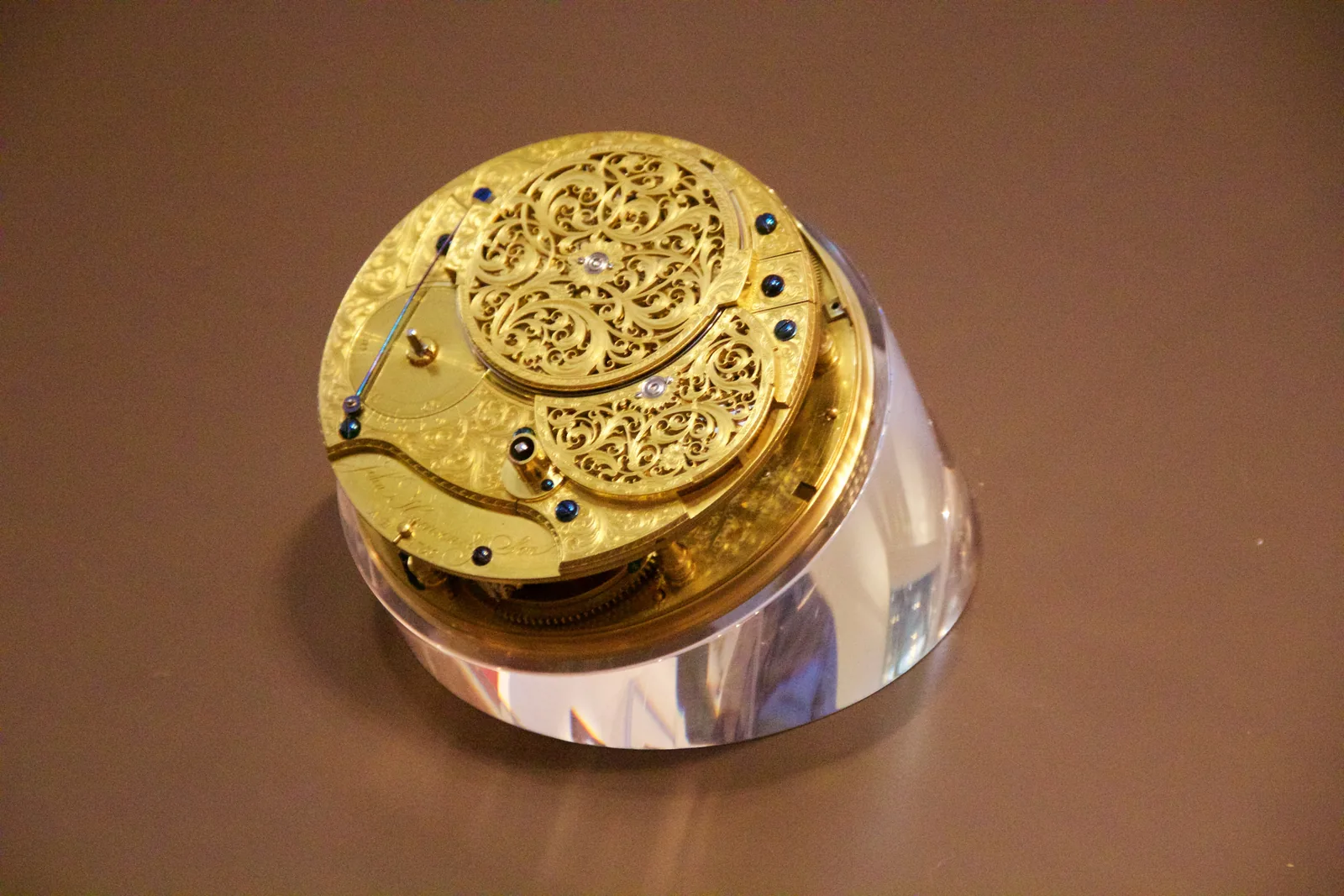
H4 used a deeply modified form of the old verge escapement. Harrison altered its geometry and fitted tiny diamond pallets.
They were not jewellery. At that scale, every contact mattered. Friction means lost energy, wear and changes in rate. An extremely hard, carefully prepared surface gave Harrison tighter control over those interactions.
The diamond pallets were unusual enough to become a subject of modern scientific study. Research published in Annals of Science has described them as an early example of diamond being used as a high-technology engineering material.
That does not mean H4 was a miraculous, lubrication-free mechanism. It remained a real machine, subject to oil, wear, servicing and adjustment. Harrison's achievement was not to abolish imperfection, but to control it with remarkable discipline.
Power that was not supposed to be felt
Every spring-driven mechanical watch has a basic problem: a mainspring stores energy, but it does not necessarily deliver the same torque when fully wound as it does near the end of its reserve.
H4 used a fusee connected to the going train to compensate for that variation. As the spring's pull changed, the fusee altered the mechanical leverage through which that force reached the movement.
Harrison's architecture also incorporated maintaining power, allowing the movement to keep receiving energy while the watch was being wound, together with a remontoire that further isolated the regulator from irregularities in the train.
In precision timekeeping, having energy is not enough. The regulator needs that energy to arrive predictably.
A watch that reacted to heat
Temperature was another adversary. A ship leaving England for the Caribbean could subject a watch to very different thermal conditions, and the properties and dimensions of its materials changed along the way.
Harrison used a steel-and-brass bimetallic compensation system acting on the regulation of the balance spring. Because the two metals expanded differently, temperature change produced a compensating movement in the mechanism.
In other words, the watch could respond to heat and correct part of its effect without electronics, sensors or software - only geometry, elasticity and materials.
Five beats a second
One of H4's most intriguing features could be heard. Royal Museums Greenwich puts it neatly: its secret announced itself in the speed of its ticking.
H4 made five beats per second. In modern watchmaking language that is 18,000 vibrations per hour, corresponding to a complete oscillation frequency of 2.5 Hz.
Today that number does not sound extreme. Twentieth-century watches made 28,800 vph commonplace, and 36,000-vph movements became famous in their own right. Context changes everything, though. For a portable watch in the 1750s, H4's regulator carried exceptional energy and speed.
The point was not merely to make the watch 'run faster'. A well-energised, stable oscillator is relatively less disturbed by small external shocks. Harrison wanted the ocean to matter less.
The voyage that had to prove everything
In 1761, the moment arrived. Harrison was already 68, so his son William carried H4 aboard HMS Deptford for the trial voyage to Jamaica.
The watch was not travelling as an accessory. It was travelling as an experiment - and as the physical result of decades of work.
Approaching Madeira, one of those episodes occurred that sounds almost too neatly written after the fact. William used H4 to estimate that land would appear sooner than the crew expected. The prediction impressed the captain.
The real examination came with the Jamaica result. The most widely cited calculation states that after roughly 81 days, applying the watch's previously established rate produced an error equivalent to about 5.1 seconds - comfortably within the most demanding limits set for the longitude reward.
The machine had crossed the Atlantic. And it still knew what time it was.
The machine had crossed the Atlantic. And it still knew what time it was.
And even that was not enough
It would be satisfying to end the story there. Harrison solves the problem, the authorities verify the result, the inventor receives the prize. Curtain.
Science, bureaucracy and money are rarely that tidy.
The Board of Longitude argued that a single trial was not sufficient. Questions remained about reproducibility, how the watch's rate should be interpreted and whether other makers could build comparable instruments.
Relations deteriorated. A second major trial followed in 1764, this time to Barbados. H4 again performed within the strictest requirements, but payment and the conditions imposed on Harrison turned the matter into a long-running dispute.
The story would eventually involve the Board, Parliament, Astronomer Royal Nevil Maskelyne and even King George III. Harrison received substantial sums, although the convenient version in which he simply 'won the £20,000 prize' smooths over a much messier institutional reality.
By then, however, the decisive fact had been established: a sufficiently accurate reference time could be carried across an ocean.
When time became space
That is where H4's real power lies.
A clock normally answers one question: what time is it?
H4 could help answer another: where am I?
Once a navigator knew local time and could compare it with a reference time kept on board, the difference could be converted mathematically into longitude.
Time had become distance. The oscillation of a balance wheel could end up as a coordinate on a chart.
The link between time and position remains with us, even though the technology has changed beyond recognition. Satellite navigation also depends on measuring time with astonishing precision in order to infer distance and position.
Harrison did not invent GPS, of course. But the conceptual continuity is striking: to know exactly where we are, we first need to know time extraordinarily well.
H4 was not the final marine chronometer
The chronometers that eventually spread through nineteenth-century fleets were not straightforward copies of H4. Pierre Le Roy, John Arnold, Thomas Earnshaw and others developed designs that simplified and transformed marine precision timekeeping.
The Board itself commissioned Larcum Kendall to make a copy of H4. The resulting K1, completed in 1769, later sailed with James Cook and provided powerful practical evidence for the method.
H4 was too complicated and costly to become, unchanged, the watch of every ship. That does not reduce its importance.
Its historical role was not to prescribe the exact form of every chronometer that followed. It was to prove that something many considered impractical could, in fact, be done.
The beauty of a machine that had to be right
Look at H4's movement today and it is difficult to decide where engineering ends and art begins. The plates are richly engraved; bridges and cocks resemble filigree; blued screws punctuate polished and gilded surfaces.
This was centuries before CNC machining, EDM, industrial synthetic jewels and modern production tolerances. Every component had to be imagined, made, adjusted and assembled through human skill.
And then the finished machine had to be sent into the Atlantic.
Perhaps that is why H4 remains so compelling more than two and a half centuries later. Not because it is the most accurate mechanical watch ever built - it is not. Nor because every modern watch descends directly from its architecture.
It matters because it belongs to that rare class of machines that altered our relationship with the world.
Before Harrison, a clock could organise a day. After Harrison, a clock could help a ship find a continent.
John Harrison spent much of his life trying to keep a handful of seconds intact against the disorder of the sea.
He ended up achieving something much larger.
He turned time into a coordinate.
H4 at a glance
| Specification | H4 |
|---|---|
| Completed | 1759 |
| Project begun | 1755 |
| Type | Marine timekeeper / precision marine watch |
| Dial | 102 mm diameter |
| Overall dimensions | 165 × 124 × 28 mm |
| Mass | 1.45 kg |
| Frequency | 5 beats per second; 18,000 vph; 2.5 Hz complete oscillation |
| Escapement | Harrison-adapted verge with diamond pallets |
| Regulation | High-energy balance with steel spring and temperature compensation |
| Power transmission | Fusee, maintaining power and remontoire architecture |
| First major sea trial | HMS Deptford, voyage to Jamaica, 1761-1762 |
| Second trial | Barbados, 1764 |
| Collection | National Maritime Museum / Royal Museums Greenwich |
Sources and references
- Royal Museums Greenwich — H4 collection record
- Royal Museums Greenwich — Longitude found: the story of Harrison's timekeepers
- Royal Museums Greenwich — Octant associated with the HMS Deptford H4 trial
- The Seiko Museum Ginza — John Harrison (1693-1776)
- Hird, Betts & Pratt — The Diamond Pallets of John Harrison's Fourth Longitude Timekeeper-H4, Annals of Science
- Royal Museums Greenwich — K1 by Larcum Kendall
- Royal Museums Greenwich — History of the Royal Observatory Greenwich