Engineering
Two Hundred Watches Out a Window: How G-SHOCK Was Born
Before it became a culture, a design language and a watch sold by the millions, G-SHOCK began with an almost childlike question: why should a watch have to break when you drop it?
A one-line idea
In the early 1980s, Kikuo Ibe was designing watches at Casio. One day, he dropped a watch he cared about and watched it break apart. There was no cinematic vow, no secret rebellion against management. What followed was more useful: an engineering problem.
Ibe wrote a remarkably simple proposal — build a durable watch that would not break when dropped. Casio approved it, and Project Team Tough was formed in 1981. The three-person team soon had a memorable target: Triple 10. Survive a ten-metre fall, resist ten bar of water pressure and aim for a ten-year battery.
The brief took seconds to understand. It would take roughly two years to solve.
The third floor became a laboratory
The obvious first answer was cushioning. Add softer material, add more rubber, make the protective shell thicker. It helped, but the prototypes kept growing until some were roughly softball-sized. A watch that survives only by becoming a ball has solved the wrong problem.
So the team used an admirably unsophisticated test rig: gravity. Ibe dropped prototypes from the third-floor men’s-room window at Casio’s development centre, about ten metres above the ground. Then he went downstairs, looked at what had broken, changed the design and tried again.
More than two hundred prototypes went through the process. The lesson became clearer with every failure. The goal was not to stop an impact from happening; it was to stop the impact energy from reaching the electronic module in a destructive way.
The rubber ball that reframed the problem
The breakthrough came when Ibe watched children playing with a rubber ball in a park near the office. The ball hit the ground, deformed and bounced back. Its centre survived because the surrounding structure took the punishment. That suggested a better question: what if the watch module did not sit rigidly against the case at all?
The answer became the defining G-SHOCK architecture: a module suspended inside a hollow structure, isolated by selected contact points and cushioning layers that dispersed shock. The watch did not need to behave like a stone. In a mechanical sense, it needed to know how to fall.
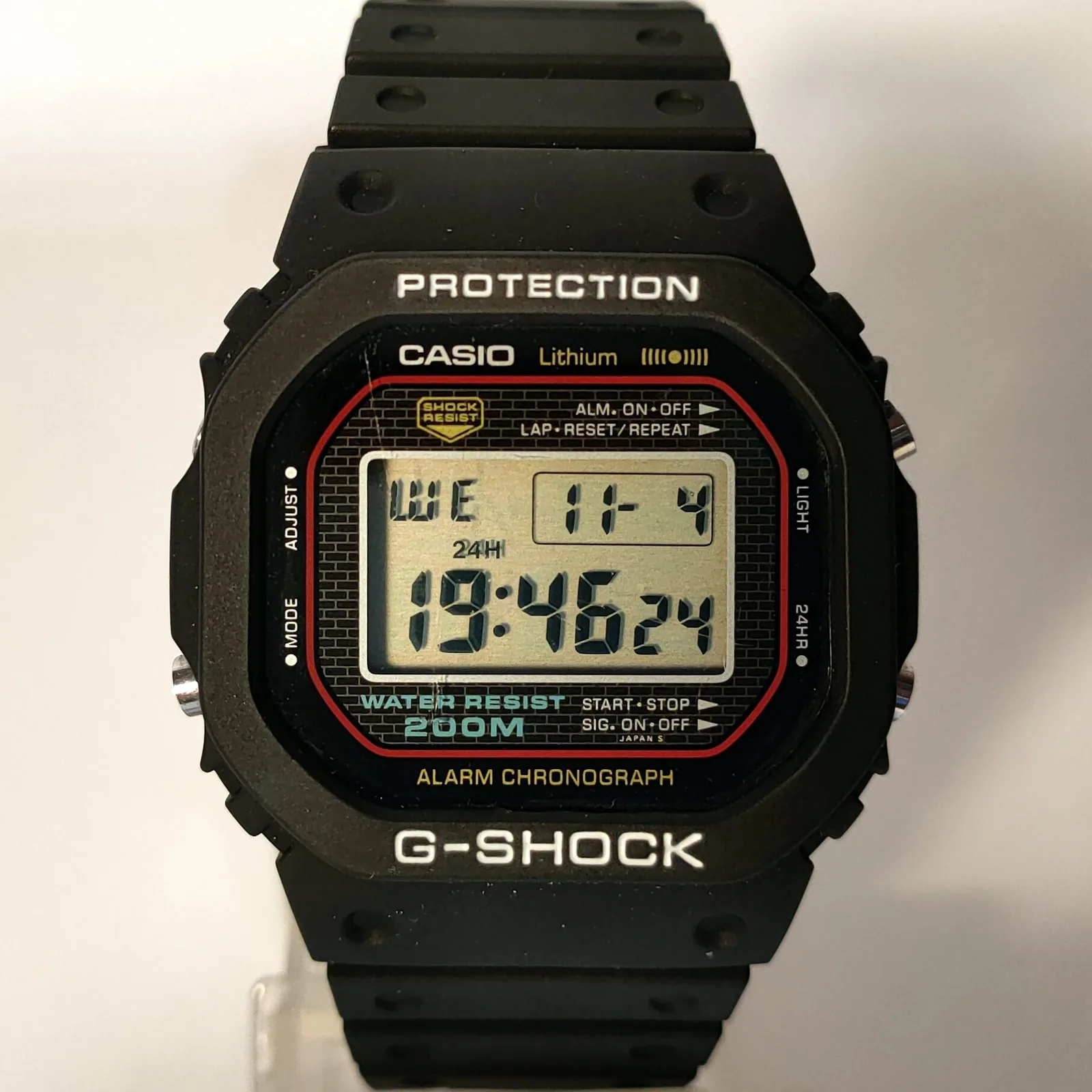
The DW-5000C arrived in 1983. Triple 10 had driven development, although the first production watch did not literally tick every box: it delivered 20-bar water resistance and a stated seven-year battery life. What mattered was the concept. A digital watch no longer had to be treated as a fragile electronic object.
The real revolution was expectation
G-SHOCK eventually escaped the engineering department and became part of sport, workwear, street culture, music and professional equipment. The thick guards, recessed controls and purposeful bulk that once existed for survival turned into a visual identity of their own.
Yet the most revealing part of the story happened before the fame. Ibe did not solve the problem in a flash of genius. He dropped a prototype, broke it, learned something and dropped another. Innovation here was less a lightning strike than a routine.
Today you can spot a G-SHOCK across a room. Its story, however, began with something almost comically unglamorous: a third-floor window, gravity, and the willingness to walk downstairs more than two hundred times.