History
The Watch That Crossed the Atlantic Twice with Amelia Earhart
Amelia Earhart’s 1937 disappearance is such a powerful story that it tends to swallow everything that came before it. Yet years before that final flight, a Longines chronograph had already accompanied two defining Atlantic crossings — two moments that helped turn Earhart into one of aviation’s most recognisable figures.
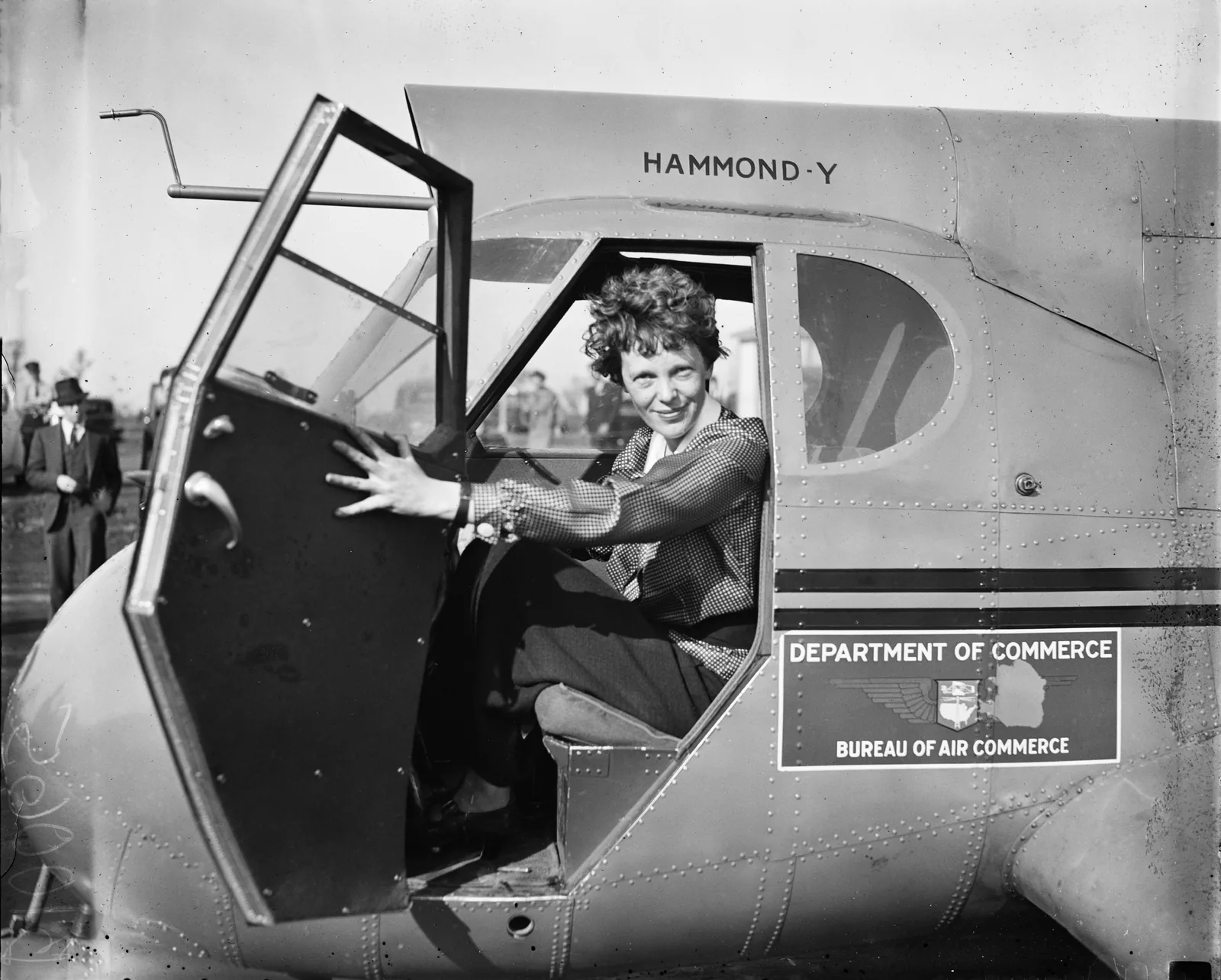
1928: crossing the ocean before conquering it
In June 1928, Amelia Earhart became the first woman to cross the Atlantic by aeroplane. The detail matters: she did not pilot that crossing. She travelled aboard Friendship with pilot Wilmer Stultz and mechanic Louis Gordon. Being precise about that does not diminish the milestone; it makes the trajectory that followed more remarkable.
In early aviation, time was part of navigation. Long before GPS and modern avionics, accurately tracking elapsed time fed calculations involving course, speed, fuel and position. Longines had already built a reputation around timing and aviation, and the company documents Earhart using a Longines chronograph with calibre 13.33Z on her Atlantic crossings of 1928 and 1932.
The 13.33Z deserves its own footnote in watch history. Introduced in 1913, it was among the early compact chronograph movements developed specifically for the wrist, operated through a pusher integrated with the crown. At a time when a chronograph still carried the flavour of a scientific instrument, taking one into an aircraft was very different from wearing one as a decorative complication.
1932: this time, alone
Four years later, Earhart returned to the Atlantic under entirely different circumstances. On 20 May 1932, she took off from Harbour Grace, Newfoundland, intending to fly the ocean solo. Fourteen hours and 56 minutes later she landed in Northern Ireland, becoming the first woman to complete a solo, nonstop transatlantic flight.
Longines again associates a 13.33Z chronograph with that crossing. It is easy to forget what those hours meant: noise, vibration, weather, imperfect information and a pilot constantly turning time, fuel, speed and position into decisions.
The watch did not fly the aeroplane. It did not remove uncertainty. It did something more modest and more useful — it supplied a precise reference in a cockpit where every reliable reference mattered. That helps explain why watchmaking and aviation became so closely intertwined in the first half of the twentieth century.
A record-breaker who understood what records could do
Earhart understood early that her flights could carry meaning beyond the numbers. In 1929, she helped found The Ninety-Nines, an organisation created by and for women pilots. Her public career became evidence that the new world of aviation did not belong to one gender.
That combination of technology, risk and public visibility made her an obvious figure in the story of aviation timing. It also creates a trap for watch history: once a documented relationship becomes famous, it is tempting to stretch it until every later event contains the same watch.
What we can say with confidence is that Longines links the 13.33Z to Earhart’s Atlantic crossings in 1928 and 1932. We do not have equally solid evidence that the same watch accompanied her on the final flight of 1937. The distinction is worth preserving.
1937: the mystery does not need an invented watch
In 1937, Earhart and navigator Fred Noonan set out to fly around the world near the equator. They left Miami on 1 June and reached Lae, New Guinea, on 29 June. On 2 July they took off for tiny Howland Island in the central Pacific. They never arrived.
The disappearance became one of the twentieth century’s enduring mysteries. That makes it irresistibly easy to place a particular watch in the cockpit and let it vanish with her. But good history does not need to turn uncertainty into certainty simply because the image is powerful.
The Longines chronograph already has a better story. It crossed the Atlantic with Earhart as the world was beginning to learn her name. It crossed again when she was no longer simply the famous woman aboard an aircraft, but the pilot proving on her own terms what she could do.
Sometimes the most compelling object is not the one that disappeared with a legend. It is the one that was present while the legend was being made.