History
Royal Oak: The Famous Failure That Never Happened
For decades, one version of the Royal Oak story has been almost too good to resist: Audemars Piguet launched an oversized, outrageously expensive steel sports watch in 1972, nobody wanted it, and only years later did the world catch up. The company’s own archives tell a more interesting story.
The overnight sketch was real
On 10 April 1970, the day before the Basel fair, Audemars Piguet’s distribution agents put an unusual challenge to managing director Georges Golay. They wanted a prestigious steel sports watch — modern, waterproof and unlike anything the company had made before.
Golay called Gérald Genta. The designer worked through the night and delivered the sketch that would define the Royal Oak. Audemars Piguet’s historical record traces the visual idea to old diving helmets: exposed fasteners, a gasket-like visual language and the impression of a piece of equipment assembled to withstand pressure.
One popular embellishment can be removed immediately. Audemars Piguet was not on the brink of collapse, throwing one last desperate idea at the quartz crisis. Its archives describe the years leading up to 1970 as a period of strong growth. The Royal Oak was a gamble, certainly — but a gamble about where luxury might go next.
One night to draw, two years to build
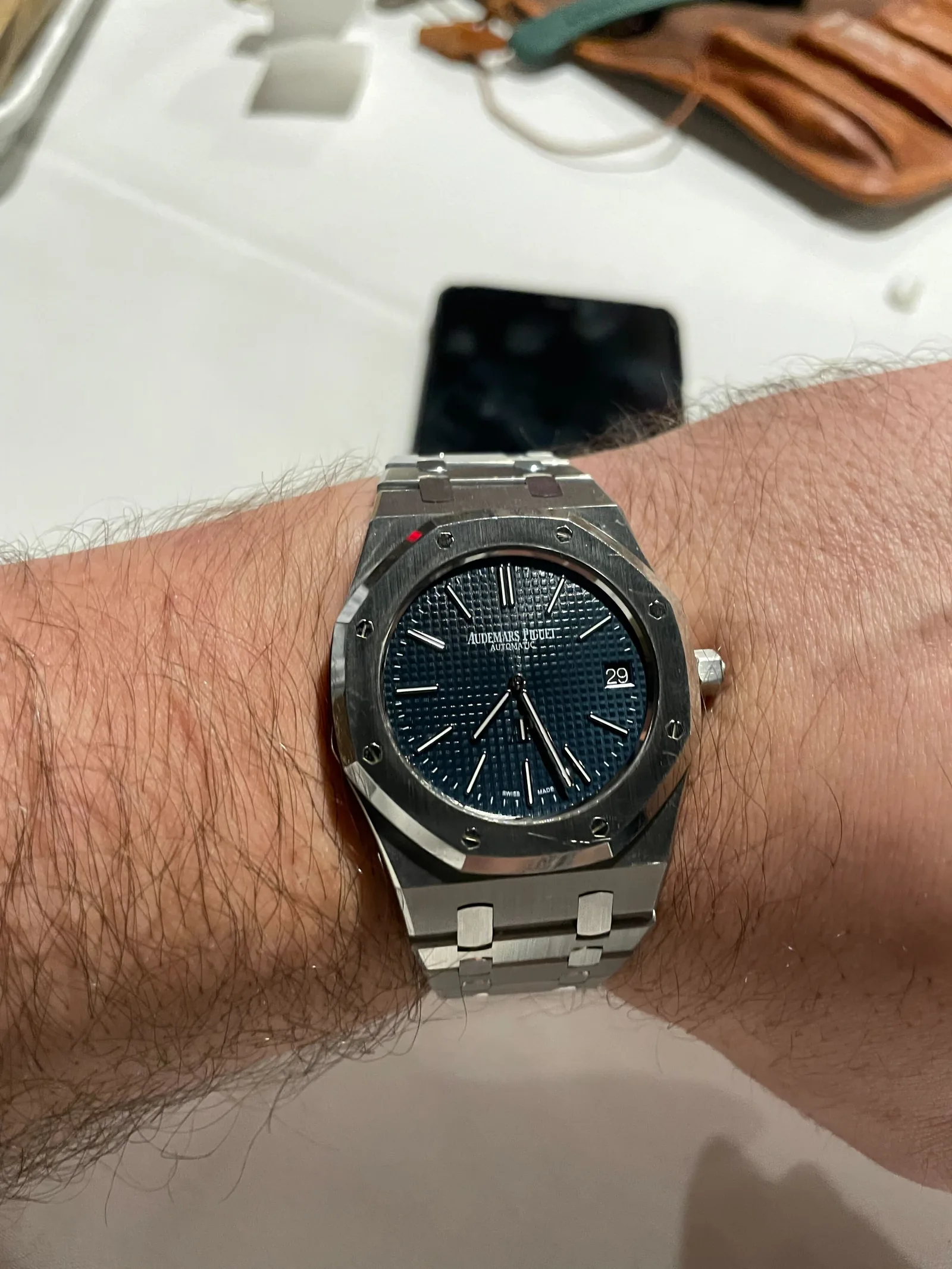
The sketch was fast. Industrialising it was not. It took roughly two years to turn Genta’s idea into a watch that could be produced. The case, dial and integrated bracelet called for suppliers able to finish steel with the kind of care normally associated with precious metal. Inside, calibre 2121 kept the 39 mm watch remarkably slim for its bold footprint.
Its most famous detail is also widely misunderstood. The eight hexagonal elements on the bezel are not screws tightened from the front. Their heads sit locked into the bezel, while nuts from the caseback side clamp the construction together and compress the large gasket. That is why the visible hexagons can sit in a controlled orientation: the assembly method, not decorative wizardry, makes it possible.
Even the material choices evolved. Early exposed steel components could suffer from seawater corrosion, and Audemars Piguet soon moved to precious metal for those parts. The Royal Oak we now treat as an obvious solution was anything but obvious while it was being engineered.
The scandal was steel priced above gold
When the Royal Oak reached Basel in April 1972, its price was CHF 3,300. Audemars Piguet itself had gold watches listed for less; one gold model in the catalogue was CHF 2,990. That was the real provocation. Buyers were being asked to accept that luxury could be rooted in design, labour, finishing and the difficulty of working steel — not simply in the intrinsic value of the metal.
The watch did provoke scepticism. What it did not do was collapse commercially in the way later folklore suggests. Audemars Piguet’s records show 565 pieces produced and 490 delivered during 1972. For the manufacture, that already represented a record number of identical watches delivered in a single year. By 1973, Georges Golay was calling it a best seller.
So why does the failure story refuse to die? Because it fits beautifully. The watch looked strange, cost an extraordinary amount and took time to become the cultural giant we know today. Somewhere along the way, early controversy was rewritten as universal rejection.
The truth is radical enough
Correcting the myth does not make the Royal Oak less daring. It makes the risk clearer. Audemars Piguet was asking the market to pay haute-horlogerie money for steel, to see an integrated bracelet as part of the architecture, and to value finishing and design more highly than the traditional hierarchy of materials.
The watch helped establish a category that now feels perfectly normal: the luxury sports watch. Later came other interpretations from other houses. In 1972, however, the underlying question was disruptive: if steel can cost more than gold, what exactly are we paying for when we buy luxury?
The answer helped reshape watchmaking. Perhaps that is why the idea of an initial disaster is so seductive. The Royal Oak was not a failure that eventually became a success. It was a success that eventually acquired a wonderfully dramatic failure story.